It all began with a regicide. On January 16, 1793, the National Convention in Paris sentenced Louis XVI to death. Rebellion is perhaps among the deepest roots of science: the refusal to accept the present order of things. Among those who took the fatal decision was a friend of Robespierre called Lazare Carnot. Carnot had a passion for the great Persian poet Saadi Shirazi. Captured and enslaved at Acre by the Crusaders, Shirazi is the author of those luminous verses that now stand at the entrance of the headquarters of the United Nations:
All of the sons of Adam are part of one single body,
They are of the same essence.
When time afflicts us with pain
In one part of that body
All the other parts feel it too.
If you fail to feel the pain of others
You do not deserve the name of man.
Perhaps poetry is another of science’s deepest roots: the capacity to see beyond the visible. Carnot names his first son after Saadi. Sadi Carnot is thus born out of poetry and rebellion.
If more gently than Orpheus who moved even the trees you were to pluck the zither the life-blood would not return to the vain shadow Harsh fate, but its burden becomes lighter to bear, since everything that attempts to turn back is impossible. (I, 24)
WHERE DOES THE ETERNAL CURRENT COME FROM?
Clocks may well run at different speeds in the mountains and in the plains, but is this really what concerns us, ultimately, about time? In a river, the water flows more slowly near its banks, faster in the middle—but it is still flowing… Is time not also something that always flows—from the past to the future? Let’s leave aside the precise measurement of how much time passes that we wrestled with in the preceding chapter: the numbers by which time is measured. There’s another, more essential aspect to time: its passage, its flow, the eternal current of the first of Rilke’s Duino Elegies:
The eternal current Draws all the ages along with it Through both realms, Overwhelming them in both.
Past and future are different from each other. Cause precedes effect. Pain comes after a wound, not before it. The glass shatters into a thousand pieces, and the pieces do not re-form into a glass. We cannot change the past; we can have regrets, remorse,
I have an enduring passion for Anaximander, the Greek philosopher who lived twenty-six centuries ago and understood that the Earth floats in space, supported by nothing. We know of Anaximander’s thought from other writers. Only one small original fragment of his writings has survived—just one:
Things are transformed one into another according to necessity, and render justice to one another according to the order of time.
“According to the order of time”. From one of the crucial, initial moments of natural science there remains nothing but these obscure, arcanely resonant words, this appeal to the “order of time.”
Let’s begin with a simple fact: time passes faster in the mountains than it does at sea level.
The difference is small but can be measured with precision timepieces that can be bought today on the internet for a few thousand dollars. With practice, anyone can witness the slowing down of time. With the timepieces of specialized laboratories, this slowing down of time can be detected between levels just a few centimeters apart: a clock placed on the floor runs a little more slowly than one on a table.
It is not just the clocks that slow down: lower down, all processes are slower. Two friends separate, with one of them living in the plains and the other going to live in the mountains. They meet up again years later: the one who has stayed down has lived less, aged less, the mechanism of his cuckoo clock has oscillated fewer times. He has had less time to do things, his plants have grown less, his thoughts have had less time to unfold… Lower down, there is simply less time than at altitude.
I stop and do nothing. Nothing happens. I am thinking about nothing. I listen to the passing of time.
This is time, familiar and intimate. We are taken by it. The rush of seconds, hours, years that hurls us toward life then drags us toward nothingness…. We inhabit time as fish live in water. Our being is being in time. Its solemn music nurtures us, opens the world to us, troubles us, frightens and lulls us. The universe unfolds into the future, dragged by time, and exists according to the order of time.
In Hindu mythology, the river of the cosmos is portrayed with the sacred image of Shiva dancing: his dance supports the coursing of the universe; it is itself the flowing of time. What could be more universal and obvious than this flowing?
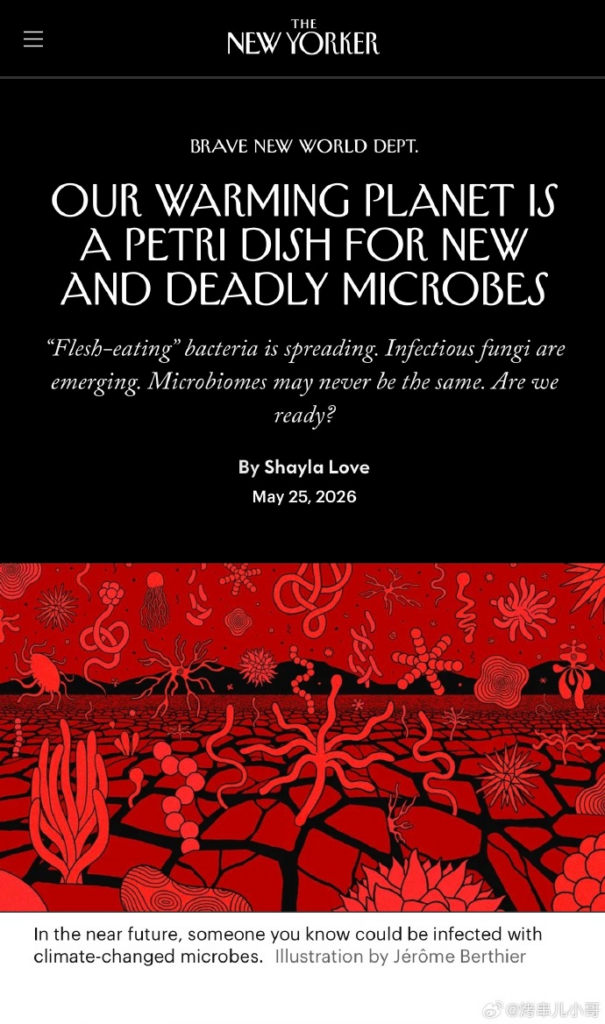
去年,致力于保护濒危动植物的国际自然保护联盟(IUCN)成立了首个专门负责全球微生物编目和保存的小组,承认微生物也是值得拯救的生命形式。该小组将编制一份濒危微生物及其栖息地清单,并鼓励收集生活在极端环境(例如沙漠或深海)中的稀有微生物。一项名为“微生物库”(Microbiota Vault)的类似项目旨在保存来自我们食物链和消化系统的微生物物种。来自贝宁、巴西、埃塞俄比亚、加纳、老挝、泰国和瑞士的团队正在收集近两百份发酵食品样本和一千多份人类粪便样本。该项目的灵感来源于斯瓦尔巴全球种子库(Svalbard Global Seed Vault),后者保存了数千种植物:如果地球环境发生巨大变化,导致某种微生物在野外消失,人类将有机会将其重新引入。